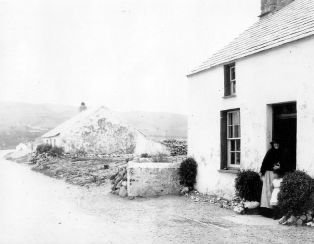
INMAN COTTAGE
A BRIEF HISTORY OF BORTH
Borth is the northernmost coastal village in Ceredigion, formerly Cardiganshire, and lies in the parish of Llanfihangel Genau’r Glyn. It encompasses two townships, Cyfoeth y Brenin and Henllys. These confusingly termed townships were simply divisions within parishes and have nothing to do with towns as we know them. The village includes the hamlets of Glanwern, Penbont, Dolybont and Ynyslas as well as the farms contained in Cyfoeth y Brenin and Henllys. Borth straddles a shingle bank formed between the sea and a large fenland, called Cors Fochno, traditionally thought to mean the Fenland of Pigs. Aberystwyth historian Gerald Morgan asserts that it is named after an unknown ancient called Mochno. That may be so but according to folklore:
A prince who lived well to the south of the Borth area decided to take stock of his realm. The prince’s entourage travelled with their own food supplies, amongst which were pigs. A large tract of marshland marked the northern boundary of his domain and, according to the story, when he arrived the locals there had never seen pigs before, so to commemorate this wonder they named the fen Cors Fochno to mark the event.
Perhaps what can be read from this is that these were the first domesticated pigs the locals had seen, as opposed to the abundant wild boar that roamed ancient Wales. This prince may have been Gwaethfoed who gave his name to a rocky outcrop in the fenland near Ynyslas called Ynys Gwaethfoed (Gwaethfoed's Island). His descendants supposedly began the Pryse dynasty of Gogerddan. Two of his sons we know of one was Cedifor who was Rhys Grug's bard and the other, according to Giraldus Cambrensis, was Ethenoweyn the lay Abbot of Llanbadarn Fawr. Gwaethfoed lived in the Vale of Aeron and claimed descent from Gwyddno Garanhir (Gwyddno Longshanks) circa 580 ad. The latter's name resonates through the early history of the north Ceredigion coast.
Exactly how and when Borth came into being is lost in the mists of the distant past well before written history. Its first inhabitants may have settled in the area farming the high ground and fishing the sea; especially for herring which must have been abundant well before Borth's establishment. It has been conjectured that a sea port called Hafan Gwyddno or Porth Gwyddno mentioned in ancient texts is Borth. The stretch of water between Sarn Cynfelin and the Dyfi is called Maes Gwyddno (Gwyddno's Meadow), (North, 1957, p175). The end of Sarn Cynfelin is called Caer Gwyddno (Gwyddno's Fort) unromantically called Patches shoal in English. By the Middle Ages there were a few permanent dwellings tucked on the sea edge on the southern high ground and possibly others on the shingle bank that ran northwards.There may have also been dwellings around the old Leri river mouth as both Borth and Aberleri are named as separate locations in the late 14th century. The association with Gwyddno is contested; but with three topographical features in the area bearing his name, surely gives it some credibility. It was never a port, more a haven or landing place. Ffylip Brydydd used the name Porth Gwyddno in a poem when he was looking southward across the Dyfi in 1216. Recently another original name has appeared...Porth Heurac. The denial of Gwyddno Garanhir having any association with the north Ceredigion area is questionable when considering that in 2022 the existence of Cant're Gwaelod is now tenable.
Large groups of seasonal herring fishermen had been drawn to north Ceredigion waters for centuries. This is in accordance with later descriptions of the area in Elizabethan times, when Borth and the Dyfi were mentioned as gathering places for such fishing fleets. Boats could shelter on the beach from the easterlies that blow in the autumn, especially inside Trwyn Cyntaf (First Point), a much more convenient arrangement than negotiating the Dyfi bar. This long established practice may have given this area with its little gathering of dwellings the name Borth which is from ‘porth’....harbour or landing place; in the context of it meaning shelter. It has only been spelled Porth on rare occasions as in the maps of Thomas Kitchen 1765 and J. Roper 1805.
Borth and Aberleri are named for the first time in a church terrier dated 1373. Also mentioned in the same document are the turbaries, peat digging rights, on Cors Fochno which the church kept for centuries until their sale in the 1960s. All this was written in Latin, and is contained in the Llanfihangel Castell Gwallter parochial records, which stated:
Decimae Halecis Pertinentis Ad Borth Et Aberlery (Bygones, 1876, p. 28)
The Castell Gwallter in the church name comes from a nearby castle site near Blaenwaun Farm. At the very edge of a massive drop into the Llandre valley are the remains of a motte and bailey earthwork castle called Castell Gwallter, which means Walter’s Castle. It was built by Walter De Bec during the Norman ascendancy in Ceredigion, between 1110 - 1135. Often attacked by the Welsh, it was razed to the ground in 1136 by Owain and Cadwaladr, princes of North Wales. After rebuilding, the princes of South Wales, Cadell, Maredudd and Rhys, attacked it persistently and finally, in 1153, Rhys and Maredudd completely destroyed the structure to prevent re-garrisoning by the Normans. The nearby spring that was its water supply on the high escarpment still exists to this day. Llanfihangel Castell Gwallter is the old name for the church, but since Tudor times has been known as Llanfihangel Genau’r Glyn (St Michaels at the Mouth of the Glen).
In the past Borth was in the township of Cyfoeth y Brenin, and the northern part, built on the shingle bank, was known as Morfa Borth (Borth Sea Place) in the township of Henllys. Nowadays, Borth has become Upper Borth, and Morfa Borth is now Borth. In the 1880s when there were 20 boats fishing from the village, many were kept on the shingle bank between today’s Evelwen and Beach Cottage. In the Llanfihangel church records and the account books of a local Friendly Society called the Castell Gwallter Ivorites, there is a further division of the village, namely Gwastad Borth. This was the meadow land that included the then Pengoitan Farm and todays Gwastad, Brynrodyn and Pengraig Farms.
Many villages on the Ceredigion seaboard developed around religious sites such as Llanon, Llangrannog and Llanrhystyd; or castle sites such as those of Cardigan and Aberystwyth. Borth did not, and so it is not surprising that there has always been a folkloric supposition that the village's founding was by outcasts from the social constraints prevalent in ancient times. It is a settlement largely independent of church, castle or manor house and its small fishing community was founded, so folklore tells us, by Teulu Sion Dafydd .... John Davies’ family. Tradition deems that Sion Dafydd and his wife Sian were the first couple to inhabit the place that would become Borth...a sort of Adam and Eve. The author D. W. Morgan, whose parents were of Borth stock, says he was descended from a branch of this Borth family, namely that of Will Sion Dafydd, on his mother’s side and stated:
If all were known these successive Sion Dafydds would extend back hundreds of years, maybe casting nets off Borth shore, and killing mawn on Cors Fochno before history was (Morgan, D. W., 1948, P. 261).
In this quotation, “killing mawn” is confusing. Digging peat, in Welsh is lladd mawn, which literally translates into killing peat. Therefore, Morgan has resorted to using English and Welsh in the same phrase. The notion of the predominence of a Davies clan in Borth may have occurred more recently, around the end of the 18th century, as the names of villagers recorded in documents dated 1565, 1678 and 1745 do not support this supposition. The Rees, Williams, Daniel, Jones, Hughes, James, Lewis, Lloyd and Richards families were also prominent in Borth’s maritime affairs
The uncertainties concerning Borth’s origin fuel speculation and beg many questions. When did settlement occur and where did the first inhabitants come from? Were they a mix of the old inhabitants and the Celts prior to the arrival of the Romans? Could they be the remnants of Cunedda's army who had come to Wales from South Scotland to rid the coastal plains of the Goedelic presence in the 6th century? The Picts spoke Welsh which today is the living thriving remnant of what was spoken, with local variants throughout mainland Britain prior to the Scandinavian and Saxon incursions. The Kings of Ystrad Clyd, that is Strathclyde which means Sheltered Tranquil Vale, spoke it and this is reflected in their names. Glasgow literally means Verdant Feld or Meadow. Recent D.N.A. research indicates that many Welsh people are descended from the first post iceage hunter gatherers to inhabit Britain. Did people settle the area during the time of Cunedda's son Ceredig, who gave his name to the county? Or was it later that a beachside settlement began at Borth confident of survival because fish, presumably herrings, were plentiful at this time in the Aberystwyth area? It was recorded in The Chronicle of the Princes in 1206 that “God gave an abundance of fish in the estuary of the Ystwyth” (Smylie M. 1998, p.52). Many places must have been established prior to being recorded by name or marked on a map. Estuaries and river mouths were settled by the earliest humans in Wales as they provided an abundant source of food that was reasonably accessible. Even in ancient times the kings of Ceredigion were seafarers. Gwgawn ap Meurig, better known as Gwgawn ‘Cleddfrudd’ (bloodsword) is believed to have drowned in 872 a.d. on a sea voyage (Kirby, 1970, p.268). Gwgawn is also mentioned in Malory's Morte d'Arthur in the following three lines:
A grave for march, a grave for Gwythur
A grave for Gwgawn Bloodsword
A hidden thing is the grave of Arthur (Jones, 1959, p.213)
Recent DNA research revealed that peoples in Wales are descended from the first post ice age hunters that inhabited Britain, such as the youth buried ceremoniously at Paviland Cave glamorgan, 35,000 years ago.
Ancient historical events are associated with the Borth area, such as the Battle of Cors Fochno which took place sometime before the Norman invasion of 1066. There are different versions, but the most likely is a Welsh power struggle where Caradoc ap Rhydderch ap Iestin sought the help of the Saxon King Harold Godwinson, and his brother Tostig to defeat King Griffith ap Llewelyn ap Seisyllt of North Wales. The armies met at the coastal junction between north and south Wales, obviously the Dyfi estuary, where Tostig’s troops were joined by a sea force commanded by Harold. The battle's location points to the southern shore in the vicinity of Cors Fochno (Arch. Camb. 1851, pp 210-215). They could hardly fight on the marshland itself, so the foreshore and the beaches at Borth and Ynyslas are likely locations.
Much of Wales’ early history is contained in its poetry. In the Borth context a poem attributed to Bleddyn Ddu written around 1090 mentions the Battle of Cors Fochno which had occurred 30 years previously. In a treatise written in 1851 by T. Stephens, it states in the author's footnotes that he does not know where the places ‘Eleri’ or ‘Chwilfynydd’ mentioned in the poem are situated (Arch Camb. 1851, pp. 204-219). Eleri is surely the Leri river which flowed through Cors Fochno in ancient times to enter the sea on a wide stretch of beach that would have been ideal as a landing place for a sea force. 'Chwilfynydd' may have been the original name, or a poetically convenient form for Y Wylfa. Later in another instance was the poet Ffylip Brydydd describing the scene to the south of Aberdyfi at Borth in lines fifteen and sixteen of his praise poem to prince Rhys Gryg, sixth son of the Lord Rhys? The poem mentions waves breaking on the shingle bank at Porth Gwyddno which is a reference to Rhys Gryg having been at Aberdyfi in the winter of 1216 when the lands of Deheubarth were settled amongst the princes of south Wales. (Costigan, et al., 1995, p.174-8). This prince died fighting the English in 1233.
In Brut Y Tywysogion (Chronicle of the Princes) 1109, it was recorded that Cadwgan ap Bleddyn and his son Owain, after an escapade by the latter at Cenarth Bychan near Cardigan, journeyed to the Dyfi upon hearing that an Irish trading ship was anchored there, so that they could board her to seek refuge in Ireland. This episode came about because Owain had been smitten by the beauty of his cousin Nest, who unfortunately for him, was married to Gerald de Windsor, a Norman and friend of King Henry I (1100-35). Owain with his cohorts set about abducting her, and would probably have killed her husband to boot, if Nest had not guided him to safety. The outcome of this reckless shortlived abduction was that Owain, his father and their companions had to escape swiftly northwards. The chronicler does not mention Borth, but the party obviously boarded their escape ship from the Cardiganshire side as it was probably anchored off Traeth Maelgwyn within hailing distance. They would surely have headed for the river mouth along the shingle strand and dunes in case they missed the vessel. D.W. Morgan speculated that this ship had been far up river, probably to Llyn Bwtri, an anchorage near where an early medieval manor house stood (Morgan, D. W. 1948. p 5).
Gerald de Windsor and Nest, were the grandparents of Giraldus Cambrensis, Gerallt Gymro, Gerald the Welshman 1146-1223 who left a dynamic and invaluable record of 12th century Wales. This loquacious churchman left an account of a mission he undertook with Archbishop Baldwin in 1188 to raise men for the crusades, titled The Journey Through Wales. In his journal he mentions the crossing of the Dyfi with this minuscule description of the event:
... we crossed the River Dovey and so came to the territory of the sons of Cynan. (Thorpe, 1998, p. 181).
This is one of the rare instances when, unfortunately for posterity, he forsook his garrulousness. Another of his works, The Description of Wales, gives details of the appearance of ordinary Welsh people and a day to day account of their lives, as well as the flora and fauna of Wales, including a mention of beavers (afanc) on the river Teifi.
At that time Aberdyfi meant simply the mouth of the Dyfi, as there was as yet no such settlement as Aberdyfi. In all probability only a ferryman’s abode and an inn existed at the site until the 1700s. Borth was seldom mentioned in connection with the ferry crossing as somewhere along Traeth Maelgwyn lay the southern ferry landing place. From there a track led past Moelynys and on to Borth, a mile south along the shingle bank. In the 18th century the Dyfi estuary with its developing small anchorages such as Carreg that facilitated the export produce of local mines often warranted more cartographic attention than small farms and fishermen’s cottages, a few miles away, that constituted Borth.
There is a presumption that the only Dyfi crossing point was at the end of the track along the shingle bank where Borth stood, or where it would stand, and from this travellers such as the Lord Rhys in 1156 and Giraldus Cambrensis in 1188 could therefore have travelled through the area. This is problematic as the Dyfi estuary is vast and may have had other crossing places elsewhere up the estuary for larger bands of travellers. It is more than likely that both the Lord Rhys and Geraldus Cambrensis with their respective entourages crossed the Dyfi by fording it well up the estuary near Machynlleth. It would be a few more centuries before there was a sizeable ferry at the rivermouth for carrying horses and farm livestock. When livestock droving became more active in the 18th century larger ferries came in to use to transport Merionethshire farm animals to North Cardiganshire. They landed at Ynyslas and grazed on fields such as those belonging to Simon Hughes at Ty Mawr Farm around 1760. Some of the fields were called "Halfpenny" indicating charges to the drovers. From here the aminals were driven to Aberystwyth then on to Tregaron and eventually to London.
Small groups or lone travellers journeying north used the track down from Rhydypennau or the coastal path from Clarach over Rhiw Fawr. It was probably easier to walk under the cliffs at low tide. Another way was to follow the route from Llandre church over the top via Cilolwg and Rhiwlas farms, down Lon Goed to Borth and along the strand to the Dyfi. Of all the possible access points on the southern side of the estuary, the shortest ferry boat crossing was at the end of the Borth/Ynyslas route, especially for the mariners of Borth who had to access the port facilities of Aberdyfi from the 18th century onwards. T. Wynne Thomas’s history of the ferry maintains that this route had existed and been controlled since ancient times by either the ruling princes of Wales, the crown, church or the gentry. In the 15th century the lessee, under the Crown was Jenkin ap Iorwerth of Ynys y Maengwyn. The ferry boat crossing was between today’s Aberdyfi and the pebbly beach site opposite, called Cerrig y Penrhyn.
In the 14th century, whilst waiting to be ferried southwards from Merionethshire to join his beloved, the brilliant priapic poet Dafydd ap Gwilym became a little exasperated with the vagaries of the weather affecting the ferry service across the hazardous Dyfi when he chides the
Curly-topped, loud-crying wave,
Bar not, fair hopes my passage
To that shore, where waits my reward,
Make no delay, no hindrance.
(“The Wave on the River Dyfi” by Dafydd Ap Gwilym)
This poem's reference to rough seas affecting the ferry service confirms that the location of the crossing was at the river mouth.
Even though for centuries royalty or religious orders had fishing rights over rivers, estuaries and beaches, there were still some stretches of the coastline not under their governance. Subsistence sea fishing was probably undertaken free of any impost in medieval Wales, other than in major centres like Aberystwyth, where it was a well organised industry. In outlying areas it was left to the parish churches’ discretion to collect nominal tithes as indicated by the Llanfihangel church terrier of 1373. The surrounding countryside was controlled, and therefore, idyllic in the eyes of landowners and the clergy. The beach area was another matter; it was covered in water twice a day and those that chose to live under these conditions were viewed as also being uncontrollable in the scheme of things. Until recently the beach has often been demonised as the place of invasion and, in peace time, of idlers and social outcasts. There was outrage seven centuries ago when fisherman at Aberystwyth traded on the beach in an attempt to avoid paying their dues. There, the fishermen presumed they were beyond the periphery of any financial impositions as:
In 1302, fishermen were being fined for selling herring below the high water mark to escape paying market tolls (Smylie, M. 1998, p.52).
Prior to Elizabethan times, the western coastal areas of Britain, including Wales, had been neglected as far as any regulatory authority was concerned. Not only was there a need to tighten up this loose end of the realm in terms of the rampant piracy occuring there, but a survey was essential to assess its shipping; especially its naval and military potential for defence purposes. Slave trading was probably another concern of the authorities, although it is doubtful that the slavers reached as far as Ceredigion. The Romans, known to have taken slaves from all parts of Britain, were not the only people to ply this trade. Up to Elizabethan times and into the early Stuart period, Moroccan pirates raided south and west Britain and Southern Ireland for slaves; especially fair-haired and light skinned women and children (Gater. D. 1992, p 15). In the mid 16th century for the first time, there was to be a county by county survey of the Welsh coastline instigated by Elizabeth I, whereby her Privy Council appointed permanent Commissions for each maritime county. These investigations were conducted in 1555-6 and 1557-8 and were presented to the Piracy Commission. This resulted in the English customs system arriving in Wales, and from this came the Welsh Port Books, which are a reference source for the maritime history of the principality from the 16th century onwards. From these Elizabethan surveys comes another mention of Borth, in a quote from the report on Havens and Creeks of the County of Cardigan, (1565):
Item theris also too smale landinge places Borthe and Divi, beinge in the maner of Generglin, John Ougan esquier under the quenes
maiesties lord and owener therof (Lewis, 1927,p.31).
This John Ougan also charged Thomas Jenkin and John Vaughan ap Redderch to keep an eye on “the haven of Divi and Borth”. He was John Wogan of Wiston Pembrokeshire, who owned land in north Ceredigion. He was the grandson of Maud Clement, descended from Geoffrey Clement, who received extensive lands between the Dyfi and Rhydypennau. John Wogan sold them to John Pryse of Gogerddan in 1568 (G. Morgan, pers. comm, 2003). John Ougan was hardly an upright citizen as in 1542, as a former Sheriff of Pembroke, he was suspected of complicity in in the theft of gold from a French ship. In fact many of the Welsh gentry profited from smuggling and lawlessness up to 1850. (Breverton. T. Welsh Pirates and Privateers, p.16)
Beryl Lewis of Borth, who is researching the history of the houses and farms in the area, showed me her notes concerning the Glanleri estate. What immediately caught my attention was the name John Vaughan ap Rhydderch. Beryl's material was garnered from Thomas Jones' “History of Cardiganshire Homes and Their Families”. Gerald Morgan, Aberystwyth historian, has advised that this work be approached with caution (pers. Comm 2017). I researched other material concerning John Vaughan to follow a hunch about the man's identity.
When John Wogan sold his holdings to John Pryse of Gogerddan in 1568, they did not include around 900 acres in Cyfoeth y Brenin that belonged to the Glanleri estate. At no time over the following four centuries has any of this land come into the possession of the Gogerddan estate. The owner of Glanleri at the beginning of the 16th century was Rhydderch ap Rhys ap Meredydd, Lord of Towyn, Merionethshire. One of his sons John Vaughan inherited the estate around 1550. I contend that John as a substantial landowner living in the vicinity of John Wogan's North Cardiganshire holdings at Henllys, which included Morfa Borth and Cors Fochno, was the ideal person to watch over the “haven of Divi (Dyfi) and Borth” He is surely the man mentioned in the Piracy Commissions Report on the Borth area. If so this is one of the earliest records of a local man. The other man mentioned in the document, Thomas Jenkin, was possibly a relative of John Vaughan whose son Morris Vaughan had married Sian, daughter of Gruffudd ap Ieuan ap Shancyn (Jenkin) of Glanfread Farm. Glanfraed was a religious site dedicated to the Irish saint Bridget who apparently came to the Dyfi on a piece of turf. Many place names in Wales attest to the popularity of this saint.
Morris Vaughan became High Sheriff in 1612, but he and his wife Sian had no children, so the next to inherit the Glanleri Estate was Morris' brother Morgan Vaughan in 1630. Morgan's son David Lloyd Vaughan then inherited the estate. David's son, another Morris Vaughan became the next owner followed by his son Francis, who also became High Sheriff of the county in 1694. Francis died in 1712 and the estate passed to his daughter Mary and her husband Richard Ingram, a Montgomeryshire man. Their son Francis Ingram owned the estate next as well as becaming High Sheriff of the county in 1738. He did not marry so his sister Mary and her husband the Rev John Gwynne, who was the vicar of Llanfiangel Genaur Glyn enjoyed the estate until their deaths. After this the estate reverted to Lewis Gwynne of Monachty. What the relationship was between John and Lewis other than their surname is very unclear at the moment. Essentially this was the end of Glanleri ownership by Rhydderch ap Rhys' descendants. Other descendants of Rhydderch were to own land at Morfa Bychan and Llancynfelin. (Hughes. H.H., Fsa; Arch Cam, series 6, vol, XV11, p. 139-151). I wonder if Morfa Bychan was originally Morfa Vychan ie. Vaughans Seaplace?
Lewis Gwynne of Monachty who was an heirless bachelor, left Glanleri to his godson Captain Henry Lewis Edwardes who changed his name to include Gwynne in 1805. Captain H.L.E. Gwynne died in 1866 and Glanleri was sold to the Lewis family of Llanrhystyd. The estate had consisted of Glanleri Farm, Ty'n-shim-ne, Rhiwlas, Tu Du, Brynrodyn, Penygraig, Tir Helig, Bryn Bala, Blaenwaun, Pengoitan, Cwmcethin and Gwastad. After the Lewis' bought the estate they added Cilowg and Brynowen farms to the holdings. Miss Susan Lewis came to live in Borth after 1900 and lived at no.2, Cambrian Terrace. Her name and other family members appear on the deeds of my home Brynowen Cottage and other dwellings in the neighbourhood as the area was being developed for housing especially the land on the cliff belonging to Pengoitan Farm. The other farms of the estate were sold off by the early 1920's.
Returning to shipping affairs, in Tudor times the majority of local vessels plying the Ceredigion coast did not exceed 5 tons and were engaged in coastal trading and herring fishing. This had grave implications for the defence of the realm as witnessed by the formulation of the Piracy Commissions mentioned previously. Such concerns were no doubt fuelled by the type of incident that occurred near Borth in 1597. For many years after the defeat of the Spanish Armada there were recurring incidents of Spanish raiders making the odd punitive attack that saw places such as Penzance and Plymouth torched. One such raider hove to in the Dyfi for 10 days. The militia of both counties, Ceredigion and Merionethshire, failed to capture or destroy her as there was a shortage of manpower in the Dyfi estuary region at this time. The site of the future port of Aberdyfi only had a few houses which served the ferry route and there were certainly no naval warships to challenge the intruder. A single small cannon fired from the land would have sunk her, or at least disabled her, but she made good her escape. This ship was the Bear of Amsterdam, which later surrendered off Dartmouth, devoid of ammunition and short on food. To restock provisions and avoid conflict was probably the reason for the Dyfi stopover (Morgan, D. W., 1948, pp 11-15).
Other than Thomas Jenkin and John Vaughan ap Redderch who were instructed to watch over the fisheries of Borth and Dyfi in 1565, the first substantial mention of Borth’s inhabitants and their occupation is in a document dated 1678 titled A list of seafaring men, boatmen and bargemen from the county of Cardigan taken the 18th day of May 1678. Both townships, or in this list parishes, that comprise Borth, Cyfoeth y Brenin and Henllys, are mentioned. The names, ages and marital status of the men are provided. They are all noted as being at home so we may presume that some others were away at sea. In Henllys there were Hugh Richards 60 years of age, John Roignald 43, William Morgan 50, Hugh Owen 30, Richard Morris 24 and Morris Evan 40. In Cyfoeth Y Brenin there was a Hugh David Lloyd 63, William Thomas 58, Hugh ap Evan 40, Morgan Richards 38, Richard Davies 56, Morris David Lloyd 40, Morgan Thomas 31 and Lewis Humphrey 49. In total the Borth area had 14 men at this time, whilst Aberystwyth, a much larger place, had 19, and Cardigan had only 4, the same number as tiny Clarach. Their ages reveal that the majority were middle-aged and older. (N.L.W. Mss. 3277). This suggests that localised boating and fishing was an activity taken up primarily by retired seafarers. However so important to the well-being of the village was the herring that even into the 20th century, many mariners in the ocean-going and coastal trade arranged to be home in the autumn for the piscatorial harvest. The discrepancy between the number of men in Cardigan and Aberystwyth in this survey may be because those at Cardigan were involved in netting salmon and sewin along the river Teifi, whereas more men and seagoing boats were needed to chase the vast shoals of herring in the Aberystwyth area.
On the 22nd of November 1746 an unexpected cargo came to the village when a Portuguese ship ran aground at Trwyn Pellaf (Far Point), the tidal rockshelf at the southern end of Borth. Depositions were made to the Gogerddan Estate by local witnesses and salvagers which recorded that:
David James, David Lewis and Edward Williams, all of Borth did help to secure severall Puncheon of oyle Lemons orange Chest Pomgranets Ropes Corkwood and one sayle.....stranded on ye shore within ye Lordships of John Pugh Pryce (Jenkins, 1950-51, p.198)
This story may have boosted tales in the area which claim that many of the swarthier coastal dwellers were the descendants of crew members from wrecked European ships. Another more grisly tale possibly linked to the 1746 Portuguese wreck has come to light in a letter from A. C. Vaughan to J. Glyn Davies, dated 19th September, 1913 (N.L.W. Mss. 644). In this correspondence Vaughan was relating a story of how, when approaching Aberystwyth harbour by sea, he witnessed a screaming match between the masters of an outward bound Borth vessel and an inbound Aberystwyth craft after a near miss at the harbour entrance. The witness heard the word Portuguese, which sent the Borth man into a frenzy. Vaughan upon landing sought out the Aberystwyth skipper and enquired as to the cause of the commotion, especially the Borth man’s reaction to the word Portuguese. He was told that Borth men were cursed until the ninth generation by a dying Portuguese sailor who had been washed ashore half drowned. This foreigner had been set upon by Borth folk for his boots. As the boots were waterlogged and tight, the locals cut off his legs to get them and left him on the beach. As the Portuguese sailor was dying he cursed the perpetrators for nine generations (Vaughan, 1913, Corr. 644, N.L.W.). Was this particular sailor from the 1746 wreck and did such skulduggery go on that was not reported to the local squire at Gogerddan? As William Troughton, National Library of Wales researcher and author wryly observed “some Borth people were surprisingly fluent in Portugeuse”(pers comm 2012).
Folklore maintains that the Portuguese sailor was chased northwards by the villagers until he was eventually caught and murdered near today’s Ynyslas road bridge. Apparently for a time after this event any stranger was called a Portuguese (S.Evans and S.Clare, pers comm, 2003). There are reverberations of this event mentioned in an 1875 edition of Bygones. The article's author had met with an Aberdyfi man who had been badly frightened one night by seeing lights on the other side of the estuary moving from Borth northwards toward the sandhills opposite. It was reported that:
He evidently considered them of supernatural origin as he told me an incoherent story of a boat’s crew of shipwrecked foreigners having been murdered when they came ashore there many years ago. (Upon further enquiry, I find there was some tradition of the sort) (Holland. 1992, p. 109)
In Ceredigion up until the 17th century there were few substantial centres of population. Apart from Aberystwyth and Cardigan it was mainly a scattering of small hamlets and villages. Huge areas of the county had no hedges or fences up until 1800; however from this time the best of this open land was rapidly enclosed. Land such as the narrow Morfa Borth shingle strip was not highly prized as it had scant pasture and was prone to sea encroachment and marshland flooding in winter. It also had a centuries’ old track through it to the ferry point at Ynyslas, so settlement on the Morfa would have been of no great concern. It is more than likely that some of the first fisher-folks dwellings at this site were the seasonal shelters mentioned in the mid 1500's that later became permanent.
Folklore deems that most were built utilising the ty unnos (one-night house) system. This tradition, dating from the Middle Ages, meant a person could build a dwelling on common land overnight. There would be little objection from surrounding landowners as the 'land' in this case, a stone strand, was a useless possession as far as food production was concerned. The ty unnos structure had to have its own roof in place and smoke coming out of a hole in it by dawn of the next day. Apparently at Borth temporary walls were built of peat blocks, as there was an inexhaustible supply at adjacent Cors Fochno. The occupant would mark the boundary of his new acquisition by throwing an axe and where it landed delineated the margins of the new property. This practice was obviously not used at Borth as the houses were huddled together with occasionaql gaps left for boat access to the beach. Once the process of entitlement was established by living a year and a day in the dwelling, the owner could then rebuild the walls from packed earth or the more substantial beach stones. Early dwellings were turf roofed or thatched with bullrushes from the adjacent marshland, and were internally partitioned with wattle and daub. Waste land or not records indicate that as much as 60 pounds had to be paid to the crown for building purposes on the stoney ground. The widespread use of slate during the industrial revolution eventually heralded the demise of the age-old turf or thatched roofing of dwellings in west Wales.
By the beginning of the 19th century Borth had grown considerably, especially the northern part known then as Morfa Borth. The tithe maps of the early 19th century show a considerable number of dwellings on the seaward side of Borth’s only main street, beyond the grasp of tithe gatherers, which validates the folkloric notion of a feisty independence. All twenty or so of these had no land whatsoever, whilst others were occupied by widows..... both were reasons for exclusion from tithes. All were owner-occupied suggesting that the one night house system was practised in Borth. There is mounting evidence as Borth man, retired police Sergeant Jeffrey Davies, relates that correspondence from his maritime ancestors, the Rees family, indicate that Sabrina and Angorfa were originally constructed using this tradition. Many cottages were occupied by mariners’ widows, indicating the perilous nature of seafaring. The number of widows appropriately dressed in mourning black gave rise to the expression Brain y Borth (Borth Crows), which was eventually extended to include any Borth person who expressed a spirited independence. The origin of this term is unclear but disparate sources, folklore and the still abiding antipathy between the residents of Borth and Aberystwyth, point to the following explanation. In Welsh calling someone a "bit of a bird", tipyn o dderyn, indicates that they are perceived as being daring, irrepressable and anti-authoritarian.
The womenfolk of Borth walked southwards every week, over Rhiwfawr, through Llangorwen and on to Aberystwyth markets to sell cockles, turf, peat or woven items. They travelled in groups for companionship and conviviality born of their strong sense of identity forged by Borth being outlandish and isolated. The corvid epithet probably originated in Aberystwyth as that towns mariners insultingly called those of Borth "Peatsmoke" and they in turn referred to the towns seafarers as "Veal Meat". It is no wonder that the sight of a garrulous group of black cloaked women conjured up the image of crows who travelled and traded in a tight knit cluster. Over time all Borth natives were dubbed Brain Y Borth and beneath the initial mockery and contempt there emerged a grudging admiration for their anti-authoritarianism and fiery independence. Teachers at both secondary schools at Aberystwyth would always point out Borth as a source of disruptive students, who were often admonished by the declaration "you are not an urchin on Borth beach now in this classroom" .
Here we may consider the remark made by the Reverend D.T. Hughes in his series of articles that appeared in the Cambrian News sporadically from April to December of 1947, entitled ‘Looking Back’. He stated that there were no dwellings on the seaside of Borth’s main road one hundred years prior to 1947, which meant 1847. The tithe map of 1841 contradicts this statement. The amount of dwellings indicate that the development was decades old going back to the 1700's, unless there had been the speediest building programme ever recorded. However there may have been a time much earlier when dwellings were predominantly on the land side of the road, a safe distance from sea encroachment. This also meant that they were slightly sheltered from the prevailing south-westerlies by the high shingle bank. In some areas the rows of cottages were side on to the coastline, which meant that any heavy seas broaching the shingle bank would flow past the cottages down to the marshland causing minimal damage. Examples are at today’s White Lion Place, Craigfryn and Ty Cerrig. It was the more intrepid who built on the seaward side. Master mariner John Jenkins's father attempted to build opposite todays Trigfan but when the structure was half built he abandoned it and decided instead to build on top of Victoria Cottage, which is todays Tyrol House.
Borth residents, though dependent upon the sea, knew its many moods and how treacherous it could become in the blink of an eye. This was evident in the design and construction of their cottages. Nowadays many of the houses backing onto the sea have changed in architectural character with the addition of verandas which was unheard of in the old days. From around the mid 1800s slate took over as the preferred roofing material and the cottages with their backs to the sea used it on roofs that sloped right down almost to the ground. This proved a useful defence when huge seas crashed against the back of the village. Despite every effort, nature proved more powerful time and time again. One of the worst storms recorded was in 1896. The gale driven high tide on the 8th of October 1896, swamped the village destroying five dwellings at the southern end and severly damaging a dozen others (Cambrian News, October, 1896). We may conjecture that against the common ‘enemy’ the villagers huddled together architecturally as well as socially as the dwellings were built together in rows of six or twelve with alleys in between. The latter were to access the rear of the dwellings on both the landward and seaward sides. On the beach side a large area where the Central Garage was later to be built there was a boat storage area serving the middle of the village. The larger empty areas south of Evelwen and north from Boston House served the same purpose. The alleys leading to the beach were also used to dispose of "night soil", as there were only 70 "privies" amongst 200 dwellings. A few of the older cottages had the old plank and bucket system up until the late 1960's when the Borth sewage scheme was completed.
Some cottages near the southern end had compacted earth walls which are still there beneath a cement render finish, such as today's Journeys End and West Winds. Apparently there were others in a ruined state opposite Wesley Chapel on the sea side in the 1920s (A. Morris, pers. comm. 2003). Intriguingly earth walled houses were obviously preferred by some despite being at risk from sea damage, probably because they were warmer to live in than the stone walled ones. It was a well understood building technique bought by those who had moved from the surrounding high ground onto the Morfa. Often wall construction was a combination of both materials, stone and earth. One such earth walled cottage can be seen in the background of the photograph captioned Native Captains, Borth, on the site of today’s Glan yr Aig. It is interesting to note that D.W. Morgan refers to Borth cottages as; “white-washed wattle tenements” (Morgan, 1948, p.196) and another author commenting on an 1834 depiction of Aberdyfi says that the wattle walled cottages there were buttressed by having large slabs of stone laid against them (Lewis, 2001, p.2). One speculates that if wattle dwellings had to be supported in the sheltered environs of Aberdyfi, then surely wattle cottages at Borth would have been short lived considering their vulnerable position at the sea edge.
Many of Borth’s cottages were rebuilt in the latter half of the 19th century, to be recreated as two or three-storied Victorian houses. An example is today's Ystwyth House, formerly Mariners Cottage, in the centre of the village. This little dwelling was a hive of activity at one time as its retired sea captain owner, Thomas Davies of the sloop Venus, used to sound a bell to gather villagers together to hear important news. Captain Davies was born around 1800 and lived through the Napoleonic Wars where a relative of his, Moses Davies, had been press-ganged to fight the French. Several other local men served in the Royal Navy during these wars, namely, John Owen's David Matthews, Evan Edwards, Thomas Davies and Lewis Morgan. Borth residents had to visit the cottage of Ann ‘Gazette’ to learn how their investments or loved ones fared, since she subscribed to the Shipping News and charged others to read it. Many other cottages including those built of mud and thatch have long since vanished. When Elizabeth Jones bought Crown foreshore wasteland from the Government in 1866 there was an old cottage already on the site where later Anwylfan was built. The original cottage was probably a ty unnos. Elizabeth Jones had to pay 60 pounds to the Crown for this so called "wasteland" which was a substantial amount of money at the time. Yet in modern times much of the foreshore land between Glan yr Aig and the Lifeboat station, which had been a sloping stone beach that had been leveled after sea defence works in the 1960's, were acquired by adverse possession for a pittance compared to the Anwylfan situation over a century previously.
It was in such dwellings that seafaring families were raised, many of whom were matriarchal because of the frequently long absences of the men. In such circumstances women had to head the household, especially when, if widowed, they had the added responsibility of becoming part or sole owner of a vessel. Borth's maritime culture, cemented over the generations, engendered a degree of stoicism amongst the womenfolk who were often the business brain as well as the heart of the family. Even as early as the 1760s, records show that Borth woman Jane Pugh had half ownership in a sloop. A century later in 1871 Ann Jenkins, wife of master mariner Lewis Jenkins, became the sole owner of the barque Dorothy after her husband's death. Her nephew Captain John Jones took over the running of this vessel. Although only 32 years of age he was already an experienced seaman having captained the schooner Glad Tidings in 1865 and the barque Alice in 1869. In 1881 Elizabeth Rees, widow of Captain David Rees, ran the barque Drusus with the financial help of two other local women. One senses the strength within the old Borth community where everyone worked for each others mutual benefit; forged by the vicissitudes of seafaring. By the end of the 19th century, the wealth accumulated through shipping endeavours was reflected in better social conditions and improved housing. this meant that by 1880 there were no paupers in the village, whereas in the 1841 census there were 14.
The pace of village life which had remained unchanged for centuries quickened from around 1840, boosted twenty years later by the arrival of the railway. The age old pastoral time-clock of the seasons was now at an end. A days end at Borth in the autumnal herring season prior to this change has been described thus:
Soft soft as rabbit paws, the twilight clustered around the little curve of cottages, and dim candlelight winked and twinked from the quartered windows. Slowly the day put on the sables of the night and stole away, widow quiet, in the cortege of the sun (Richards. 1948, p.1)
Village history reveals a resourceful people, living in unimaginable poverty in tiny crowded cottages, built precariously on an exposed coastal shingle bank, flanked on one side by a gale lashed storm beach, and on the other the marshland of Cors Fochno. In Mary Lizzie Davies of Angorfa’s memoirs, life was hard and the village existed on fish, milk and bread, and contact with the outside world came once a week in the form of the Shipping Gazette, which was bought across the estuary from Aberdyfi by boat. Despite all this, they managed to prosper. Through intelligence, a fiercely independent spirit and astounding courage, the villagers made a success from a hostile environment. They were outward looking and sailed the worlds’ oceans to far-flung ports and cities, which they often knew better than the conurbations of their own hinterland. Examples are Captain William Hughes b.1842, who sailed the brig Fanny Fothergill to Australian waters in the 1870’s. Hugh James b.1844 sailed the barques Hawarden Castle and the Carmarthen Castle around the world to ports on the west coast of America, the Orient and South Africa. Captain Lewis Williams voyaged round Cape Horn a dozen times on his way to Wellington, New Zealand and Melbourne, Australia. Captain T. C. Enos knew the ports of the east and west coasts of America like the back of his hand, especially those of Peru and Chile, as he had spent years in the Peruvian Navy. Captain John Williams b.1836 sailed the small 588 ton barque Glendovey, owned by fellow villager William James, all over the world for forty years up to 1900. Captain Jones, Everton House, circumnavigated the globe many times in the 2500 ton barque Bidston Hill and was disdainful of steamship captains whom he considered no seamen at all.
For centuries Borth had been dependant on herring. The fish was so important to the economy of Ceredigion that it appears on the county’s coat of arms. In 1898, in an October edition of the Cambrian News, it was reported that Borth people would have to suffer a dire winter because of the lack of herrings in the bay. Children often went with the grown ups to chase the seasonal harvest and learned their seamanship at an early age, in what could often prove treacherous conditions.
Borth’s continued existence was reliant on the arrival of the autumnal herring. This fish was also the wellspring of its incredible seafaring ethos. For centuries large families living in tiny overcrowded earth and thatch cottages on the southern high ground eked out a living from the land as agricultural labourers, supplemented by the annual piscatorial bounty. As famine had visited them over the ages it is no wonder that they were deeply religious people who revered this life sustaining fish that symbolized God’s bounty. They saw it as manna from heaven, alleviating both physical and spiritual hunger. When they launched their small open boats it was not just a matter of fishing their home waters, Maes Gwyddnno, but the Galilee itself. In a spiritual and emotional sense they were joining Christ the Beloved Fisherman in this enterprise, and had faith in His guidance and power over the elements to secure their sustenance…they were participating in the Biblical story.
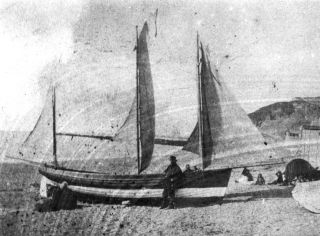
The villagers’ resourcefulness knew no bounds, even developing a unique boat design to cope with the storm beach conditions. Borth fishing boats were up to 25 feet long in length with a small transom. They had three masts, two of which were removable. The centre mast was taken down when the fish laden nets were pulled in to the boat. This also accommodated the hazardous backward rowing procedure through the surf, on to the shallow beach. Boat launching from Borth beach is not for the faint hearted; nor is returning. The five man crew of the fishing boat Ruth drowned when she was wrecked near Aberwennol on a stormy night in 1828. One source suggests this was the event that led to the naming of Craig Y Wylfa which I very much doubt as this high vantage point had been used as a lookout for centuries. During the great gale of 1857, known as the Royal Charter Gale, fishing boats and crews from Borth were lost leaving nine widows and twenty children. the gale was so named as a ship called the Royal Charter was lost off Anglesey with the loss of 450 lives. Even the most experienced boatmen can succumb to accidents. In November of 1871, there was a near disaster as ten Borth boats were caught in a storm. Although some landed safely, three were swamped, and a crewmember of the Mary Ann nearly drowned as he became entangled in nets under the overturned boat. Luckily, villagers were waiting anxiously for their return and they rushed into the surf to untangle and save the half drowned man. At the time an Aberystwyth fishing boat, the Fire Fly, had to risk beaching at Borth, from where it signaled to the searching Aberystwyth lifeboat that they were safe ashore. The previously mentioned Ruth disaster came about because of a catastrophic change in the weather. The fishing boat left Borth with south easterly winds blowing , but by the afternoon the wind had veered to the south west with increasing wind velocity as well as heavy rain showers. Normally with such a change and autumnal darkness approaching, the womenfolk would light bonfires on the beach to guide the men home. The rain however put paid to any beach beacon so the women rushed up to Craig y Wylfa with their rush and animal oil lamps hidden under their cloaks. To their horror just as they started to signal they realised that the Ruth had wrecked itself by Carreg Mulfran. All five of the crew had perished. Researcher John Ellis recently bought my attention to a note written on a baptismal record from Llandre church. It stated that Phoebe Evans whose child was baptised on 20th November 1828, had recently lost her husband John as he had drowned with four other men at Borth. This chance find gives us the name of a crew member of the ill fated Ruth.
Such sudden sea condition changes occur constantly. Such an event unfolded whereby a calm sunny morning turned into a ferocious gale by midday. This imperilled the Golden Wake a lobster boat belonging to brothers Gwilym and David Williams who recalled that they just managed to get into Aberystwyth Harbour. It also caught Ben White the skipper of the Bounty 2 which was a large open boat catering for charter trips and for sightseers. He related that with a large party aboard he was only a mile or two offshore when the sudden storm nearly caused a catastrophe, but he was fortunate like the two brothers to gain the safety of the harbour. (pers comm. G & D. Williams, Ben White, 1965).
BORTH DESIGN BOAT
In 1872, the schooner Merton of Truro was voyaging from Falmouth to Runcorn with a cargo of china clay when she was driven towards Trywn Pellaf in a southwesterly gale. Before the Aberystwyth lifeboat Evelyn Wood came on to the scene, a fishing boat put out from Borth with five men on board; Captains John Hughes, Richard Davies, William Edwards as well as fishermen John Jones and John Jenkins. They rowed through the huge seas and managed to get aboard the schooner. Knowing the local conditions, they would have been able to help her sail out of difficulty, but unfortunately there was no means of safely snapping the anchor cable that was holding her away from the rocks. With the incoming tide, she dragged her anchor and luckily grounded on sand near Trywn Cyntaf. A day later, with seas becoming calmer, she was towed away by a Porthmadoc steam tug. The Borth boat, with the five men on board, capsized on returning to shore, fortunately with no loss of life. Friends and the wives of the boatmen who had previously pleaded with them not to be so foolhardy as to risk their lives in those conditions, were at hand to help them in the time honoured way.
In the same year the brig Humility sank off Borth as she tried to run into Aberdyfi. This ageing vessel was on a voyage from Poole to Runcorn. Even though the villagers launched a boat, no rescue was needed as the weather was calm, and all the crew got ashore safely as the old vessel sank. After these incidents it was stated in the Cambrian News that, “moreover instances of this kind show how desirable it is to have a lifeboat stationed at Borth”. It was to be another hundred years before a lifeboat station was established in the village. Until that time many daring rescues were carried out by local men up until the 1960’s, often unrecorded and unappreciated.
.